Saturday, 28 February 2015
A cautionary tale
It's something that I've mentioned briefly before and something I will delve into deeper in the future but please take a look at this piece written by Michael Fremer on the excellent Analogue Planet site.
A Cautionary Tale
http://www.analogplanet.com/content/buying-used-records-cautionary-tale
Remember, if you a paying a significant amount for a record, do your research and know what it is you are paying your hard earned cash for.
Happy digging & stay safe!
Wednesday, 25 February 2015
Dusting Off The Old Records
Dusting off the old records
If you see an old Parlophone inner sleeve, you may see a reference to using an Emitex Cloth to clean your records. Cloths were once all the rage for wiping the dust from your beloved discs, they would make bold claims - "impregnated with an anti-static agent". How effective this really was at reducing static is debatable but it was certainly able to get the dust off.
In the eighties foam and velvet brushes became quite popular, along with ones that fitted on an arm that sat by your turntable and cleaned as the record played.
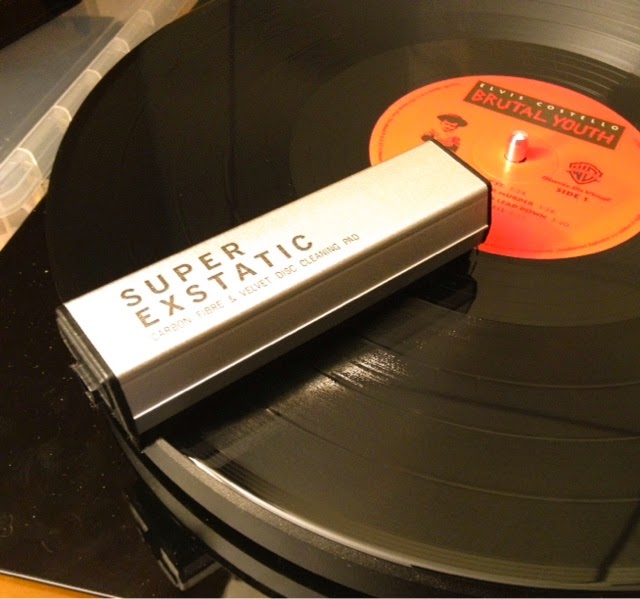
These days, brushes are all the rage, in particular the carbon fibre ones seem extremely effective in removing dust & debris. There are a number of these on the market, the one I use often tops tests (yes, I've seen record brush shoot outs!) and is the Super Exstatic (pictured below) combining the removing power of carbon fibre & velvet.
As pictured below, I gently rest it on the record while the turntable is revolving and pull the brush towards me to remove the dust. There are plenty of You Tube videos of various methods of doing this. Have fun watching them...
If you see an old Parlophone inner sleeve, you may see a reference to using an Emitex Cloth to clean your records. Cloths were once all the rage for wiping the dust from your beloved discs, they would make bold claims - "impregnated with an anti-static agent". How effective this really was at reducing static is debatable but it was certainly able to get the dust off.
In the eighties foam and velvet brushes became quite popular, along with ones that fitted on an arm that sat by your turntable and cleaned as the record played.
These days, brushes are all the rage, in particular the carbon fibre ones seem extremely effective in removing dust & debris. There are a number of these on the market, the one I use often tops tests (yes, I've seen record brush shoot outs!) and is the Super Exstatic (pictured below) combining the removing power of carbon fibre & velvet.
As pictured below, I gently rest it on the record while the turntable is revolving and pull the brush towards me to remove the dust. There are plenty of You Tube videos of various methods of doing this. Have fun watching them...
Monday, 23 February 2015
Beginners Guide To Record Collecting
The beginners guide to record collecting.
I’ve never considered myself a record collector, maybe like someone who drinks too much but won’t admit they are an alcoholic there is some denial in there. Let’s take a quick stroll through the collecting options and see if I can do some self-diagnoses.
1- Band/Artiste Collectors – This is where the majority of collections start, and certainly I do possess quite a few records by The Who. After I bought all the regular releases of albums and singles, there were solo albums that all four members made, related projects such as Tommy the orchestrated version, Tommy The Movie, Tommy the Broadway show… you get the idea. Then there is the” before they were famous” section, in this case “The High Numbers” single “Zoot Suit” (The Who went through a short period in 1964 where they were known by this name to attract the Mods). Around 1984 I saw this for sale in a Gillingham record shop for £50, not an insignificant amount for me at that time (two weeks wages in fact) but I went away to think about it, returned to buy it the following morning and it had gone. It now sells upwards of a thousand pounds. Be warned, those early fledgling near misses can be very expensive, as anyone trying to pick up early David Bowie albums can attest to. Then I discovered imports, records pressed all over the world, each with their own possible variation in track listing, mixes, covers and of course, price. There are also test pressings and promos that accompany many of these releases throughout the world. At this point, somewhat overwhelmed and not really excited about the prospect of re-buying songs Id already purchased, I stuck to collecting “tracks”. If a new compilation came out with unreleased material on it such as “Who’s Missing” I’d have that. Greatest Hits from Norway? Meh.
2- Genre – This tends to lead on from Band/Artiste. If you like this rock band, you’ll love this rock band right? Be careful when thumbing through the heavy rock session, I own a Motorhead album but no Nickleback.
3- Label- This is where we really get deep down the rabbit hole. Record Labels used to really MEAN something; it was a very clear identity to the music, that band and the fan. Record Collector magazine published a great article by Tim Greenhall last July about “Track Records”. Tim started his collection due to his big brother being a Who fan (Track were The Who’s record label from 67 to 74), then discovering Hendrix (also signed to Track Records) when he was a teenager. 25 years on, whilst he has all Track LP’s and he still only has over half the singles track released. If you get into some of the bigger labels you have a mammoth task on your hands. Conversely, some of the smaller labels with smaller runs of titles can be very heavy on the pocket.
4- Unusual Pressings – Picture discs, coloured vinyl, shaped discs, double grooved, inside out grooved, glow in the dark, holographic, laser etched…. Guilty as charged and there is plenty more out there.
5- Anything else you can think of- Oh yes, people collect records because of sleeve artist (e.g. Alex Steinweiss) disc cutting engineer (e.g. Harry Moss) & Polish Sound Postcards ( e.g. http://areyoudevoted.squarespace.com/exhibitions/2010/1/28/unsound-festival-presents-sound-postcards.html ) Not forgetting of course, Rutherford Chang who collects copies of The Beatles “White Album”, he has over 1100. I collect records that are connected to the film Ghostbusters, albums on coloured vinyl, singles with pop-up sleeves & 12” singles that smell like marshmallow. I’m really not coming out of this in a good light. Oh and another thing, there are those bootleg albums out there too.
My name is Paul and I’m a record collector.
I recently managed to get hold of a first run pressing of Les Grys-Grys single “Hot Gully Wind” to go with the 2nd run Red vinyl & 3rd run Blue. That means my State records collection is complete then? Well there are the promos, test pressings, cdr... Not forgetting the upcoming singles from The Galileo 7 & Thee Jezebels.
Collecting is a groove, not a rest for the tone arm.
Monday, 16 February 2015
Wrong Speed Different Pitch
When recording digitally, speed and pitch are altered separately. There was a time though, when these went arm in arm.
Billy Joel - Cold Spring Harbor
Usually a first pressing is the most desirable; this solo debut from Billy Joel would be an exception. Originally released in 1971 on the Family Productions label which was owned by Artie Ripp, who managed to master the album too fast making Joel sound like a sped up chipmunk on helium. That along with the awful deal he'd signed up to, caused Billy to flee to LA and work in a piano bar, which would inspire the follow up album The Piano Man.
On the other side of the platter, 2002 saw the re-issue of The Stones’ Beggars Banquet, which due to it being originally mastered too slow was now 30 seconds shorter.
Sometimes this alteration of speed and pitch was a deliberate act, The Beatles deliberately slowed down “Rain” in the mastering to give it a “heavier” feel. Speeding up a recording would often have the effect of “tightening” a performance, so was regularly used in post-production. Dylan’s Blood On The Tracks used this trick, so when CBS re-mastered it in 1981 it was 2% slower. To add to the confusion, it was half-speed mastered. This means the tape was played at half speed onto a cutting lathe, also running at half speed to produce a lacquer that would play at normal speed but with supposedly added fidelity and clarity. Whether records that are mastered in this way actually do sound better, is a subject of much conjecture on audiophile forums. Originally used by Decca Records for classical music in the sixties, MFSL became the first company to specialise in this process but by the end of the nineties they were bankrupt and this type of mastering fell out of favour.
The Police ~ Zenyatta Mondatta
Nautilus Records Half Speed Mastered
While both this and my copy of Ghost In The Machine sound so much better than the A&M versions, it's up for debate whether it's to do with the half speed mastering or A&M's legendary lack of quality control.
Subscribe to:
Posts (Atom)